Blog / Mazda Information

Free VIN Decoder: How to Look Up and Decode a VIN Number

Vin lookup

Most modern road vehicles on the road has a unique 17-character code assigned at the factory. That code is the Vehicle Identification Number, or VIN, and it contains more information about a specific car than most people realize. Whether you are shopping for a used Mazda vehicle, verifying specs before a purchase, or checking recall history, a free VIN number lookup gives you that data in seconds. Here is how VIN decoding works and where to run one.

What Is a VIN Decoder?

A VIN decoder is a tool that reads the individual characters in a 17-digit Vehicle Identification Number and returns the manufacturer-reported information encoded in each position. Each character or group of characters in a VIN contains specific information about the vehicle such as where it was manufactured, the type of engine, and the vehicle’s model year.

Federal regulations issued by the National Highway Traffic Safety Administration (NHTSA) standardized VINs in 1981. All vehicles manufactured for sale in the US from 1981 on have a 17 character VIN that conforms to this standard format.

How Does a VIN Decoder Work?

A VIN decoder breaks the 17-character number into three distinct sections, each carrying specific vehicle data:

VIN Section

Characters

What It Means

World Manufacturer Identifier (WMI)

1 - 3

Country of origin, Manufacturer, Type of Vehicle

Vehicle Descriptor Section (VDS)

4 - 8

Vehicle attributes such as model, body style, engine or restraint information, as defined by the manufacturer 

Vehicle Identifier Section (VIS)

10 - 17

Model year, manufacturing plant, and vehicle identification/production sequence information 

The fourth through ninth characters make up the Vehicle Descriptor Section, which identifies the vehicle's attributes including body style, engine type, and restraint systems. Position 9 within that section is the check digit, specific to the standardized North American VIN format. 

It is mathematically calculated to verify that the other characters in the VIN are consistent and have not been altered. The VIN search uses the information you entered and compares it to the data reported by the manufacturer, then returns the decoded results.

Where Is the VIN Number on a Car?

Three standard locations:

  • Dashboard, driver's side: Visible through the windshield at the base of the windshield on the driver's side

  • Driver's side door jamb: On the sticker inside the door frame when you open the driver's door

  • Vehicle documents: The VIN appears on the title, registration, and insurance card

How to Use the NHTSA VIN Decoder

The NHTSA vPIC (Product Information Catalog and Vehicle Listing) is the official government VIN decoder, available free at vpic.nhtsa.dot.gov. It pulls from manufacturer-submitted data for vehicles from model year 1981 forward, including passenger vehicles, trucks, buses, trailers, low-speed vehicles, and motorcycles.

To run a VIN number lookup free on the NHTSA tool:

  1. Go to vpic.nhtsa.dot.gov/decoder

  2. Enter the full 17-character VIN in the search field

  3. Optionally enter the model year to narrow results

  4. Select the decode option

  5. Review the returned fields, which include manufacturer-reported Mazda model specifications

The decoded output can be downloaded in CSV format or printed as a PDF directly from the tool.

What Does the NHTSA VIN Decoder Provide?

The NHTSA VIN decoder returns information based on manufacturer data submitted to NHTSA under the applicable federal VIN reporting requirements, including 49 CFR Part 565. That data typically includes:

  • Make, model, and model year

  • Body style and vehicle type

  • Engine displacement and fuel type

  • Manufacturing plant location and country of origin

  • Restraint system type

  • Drive type

The tool does not return accident history, title status, or odometer records. For that information, a separate vehicle history report is required. NHTSA's tool is specifically focused on what the manufacturer reported about the vehicle's specifications, not its history after it left the factory.

How to Use NHTSA vPIC for a More Detailed VIN Search

The vPIC system also supports partial VIN decoding. The API can decode VINs with fewer than 17 characters, and an asterisk can be used to indicate unavailable characters. Partial VIN results provide the available decoded information and possible matches based on the submitted characters.

NHTSA recommends contacting the vehicle manufacturer directly if you have questions about specific decoded fields, since the information displayed reflects what manufacturers have officially submitted. For questions about a specific vehicle's recall status, NHTSA's separate recalls database at nhtsa.gov is the right tool.

Shop Certified Pre-Owned at Peruzzi Mazda

Before buying any used vehicle, run a VIN number lookup free on the NHTSA vPIC tool to confirm that the specs match what the seller has listed. Keep in mind that VIN decoding returns manufacturer-reported build data only, it does not cover accident history, title status, or prior ownership records.

At Peruzzi Mazda in Fairless Hills, PA, Mazda Certified Pre-Owned vehicles go through a multi-point inspection and meet Mazda's eligibility requirements before receiving CPO status. That certification comes with manufacturer-backed coverage that does not apply to standard used car inventory. For non-certified pre-owned vehicles, our team can walk you through what's available on a vehicle's history before you get to the finance office.

FAQs

  1. What is a VIN decoder?

A VIN decoder is a tool that reads each character in a vehicle's 17-digit identification number and returns the manufacturer-reported data encoded in that position, including make, model, body type, engine, plant of manufacture, and model year. NHTSA's free vPIC decoder at vpic.nhtsa.dot.gov is the official government tool for running a VIN search.

  1. How does a VIN decoder work?

A VIN decoder parses the 17 characters into three sections: the World Manufacturer Identifier (characters 1 through 3), the Vehicle Descriptor Section (characters 4 through 9), and the Vehicle Identifier Section (characters 10 through 17). Each section carries manufacturer-encoded data. The decoder compares your input to manufacturer submissions to NHTSA and returns the decoded output. The ninth character is a mathematical check digit helps detect certain VIN entry errors. It does not prove the VIN has not been tampered with.

  1. How to use the NHTSA VIN decoder?

Go to vpic.nhtsa.dot.gov/decoder, enter your 17-character VIN, optionally add the model year, and select the decode option. The tool returns manufacturer-reported specs for that vehicle, and the results can be downloaded as CSV or printed as a PDF.

  1. What does the NHTSA VIN decoder provide?

The NHTSA decoder provides manufacturer-reported vehicle data: make, model, model year, body style, engine type, fuel type, restraint system, drive type, and manufacturing plant. The information comes from data manufacturers submit to the federal government under 49 CFR Part 565. It does not include accident history, title records, or odometer data.

  1. How to use NHTSA vPIC?

NHTSA vPIC (Product Information Catalog and Vehicle Listing) is available at vpic.nhtsa.dot.gov. Results reflect manufacturer-submitted data and can be exported or printed directly from the tool.

Posted in:

Related Posts

Best midsize SUV

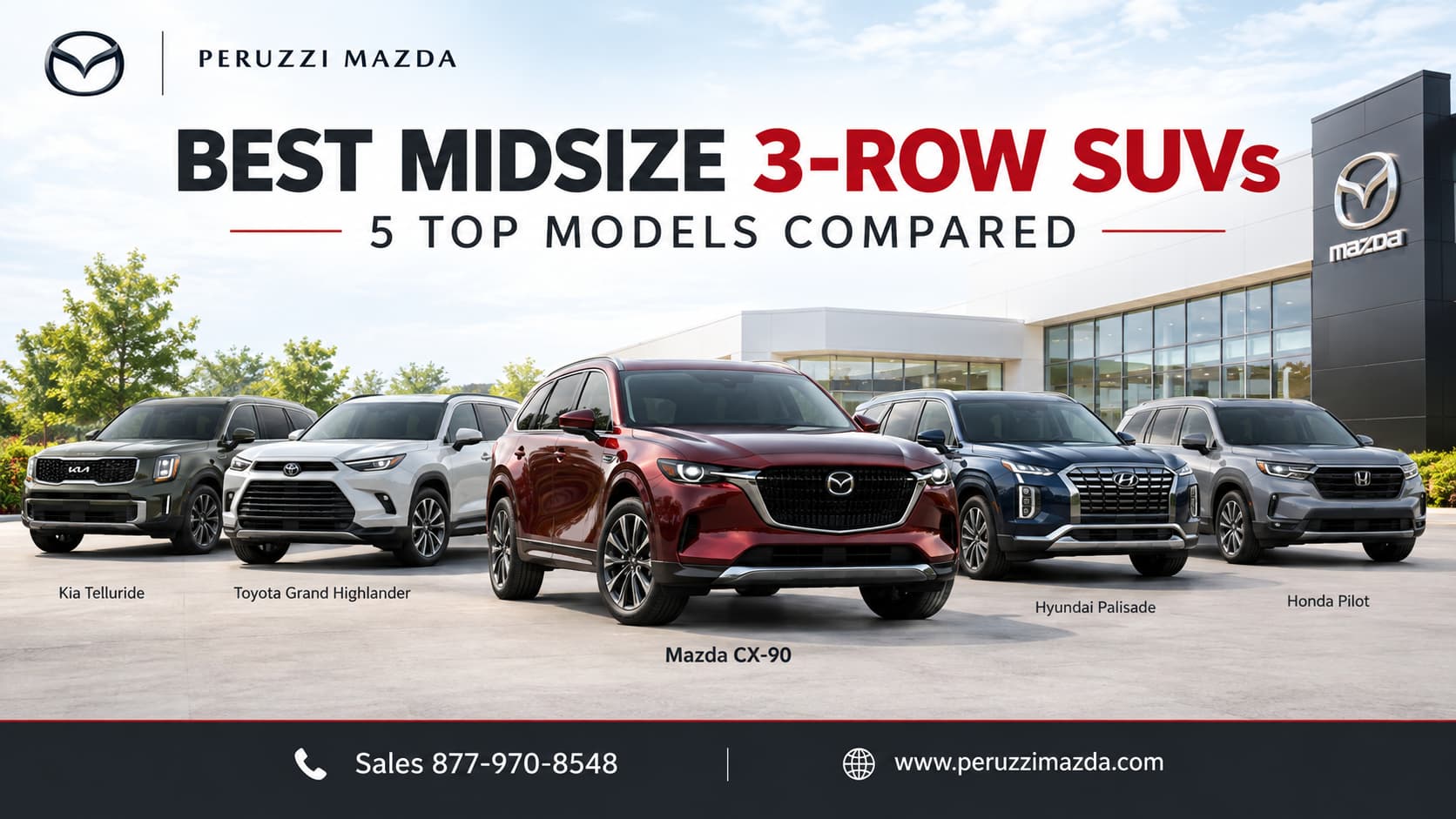
Best Midsize 3-Row SUV: How 5 Top Models Compare

Shopping for a 3-row SUV means juggling a lot of variables at once: how much cargo fits with all seats occupied, what the powertrain delivers on a daily commute versus a loaded highway run, and whether the price makes sense for what you are getting. To help buyers at Peruzzi Mazda in Fairless Hills, PA narrow the field, we compared five midsize SUVs with 3rd-row seating using specifications published by their manufacturers. Here is what the numbers say. Which SUVs with 3rd Row Seating Are Worth Considering? The midsize 3 row SUV segment includes several strong contenders. The vehicles most buyers are cross-shopping: Mazda CX-90 Hyundai Palisade Kia Telluride Honda Pilot Toyota Grand Highlander These models offer three rows of seating, with seven- or eight- passenger capacity depending on the model, trim and seating configuration. Their published specifications differ across powertrains, fuel economy, cargo capacity, towing capability, and available features. How Do the Top 3-Row SUVs Compare on Specs? SUV Horsepower Combined MPG Cargo (All Seats Up) Max Towing Seating Mazda CX-90 280 hp (340 hp Turbo S) 25 MPG 14.9 cu. ft. Up to 5,000 lbs 7 or 8 Hyundai Palisade 287 hp 21 MPG (FWD) / 20 MPG (AWD) - Up to 5,000 lbs 7 or 8 2027 Kia Telluride 274 hp 22 MPG combined 22.3 cu. Ft. Up to 5,000 lbs Up to 8 Honda Pilot 285 hp - - Up to 5,000 lbs Up to 8 Toyota Grand Highlander - Up to 34 MPG combined (Hybrid) - Up to 5,000 lbs Up to 8 What Makes the Mazda CX-90 One of the Best 3-Row SUVs? The 2026 Mazda CX-90 earned a 2026 IIHS TOP SAFETY PICK+ award. NHTSA's current 2026 testing information does not list the CX-90 among the models selected for 5-Star Safety Ratings testing. It also comes standard with i-Activ AWD across the 2026 CX-90 lineup. Key specs include: Engine: 3.3-liter turbocharged inline-6 Power: Up to 280 hp and 332 lb-ft of torque on 3.3 Turbo models; 340 hp and 369 lb-ft on 3.3 Turbo S models when using recommended premium fuel. AWD: i-Activ All-Wheel Drive standard on all trims Fuel economy: 23 city/28 highway/25 combined MPG, EPA-estimated, for the 2026 CX-90 3.3 Turbo and Turbo S models. Cargo: 14.9 cu. ft. with all seats upright; up to 74.2 cu. ft. with the second- and third-row seatbacks folded down. Towing: Up to 5,000 lbs when properly equipped Safety: 2026 IIHS TOP SAFETY PICK+. Drive modes: Mazda Intelligent Drive Select (Mi-Drive) provides selectable drive modes, including Sport and Off-Road modes; the CX-90 also offers a Towing mode. Standard i-Activsense safety features include Mazda Radar Cruise Control with Stop & Go, Smart Brake Support, Blind Spot Monitoring with Vehicle Exit Warning, Rear Cross Traffic Alert, Lane Departure Warning with Lane-keep Assist, Rear Seat Alert, and Driver Attention Alert. Second-row configurations offer 7 or 8-passenger layouts depending on bench or captain's chair setup. Is a Midsize 3rd Row SUV the Right Choice? Midsize SUVs with 3rd-row seating provide three rows of seating in a smaller vehicle class than full-size SUVs such as the Chevrolet Suburban and Ford Expedition. They offer: Seating for 7 or 8 without the bulk of a full-size platform Cargo flexibility that can provide additional passenger and cargo capacity compared with many two-row SUVs. Several models in this comparison offer towing capacities of up to 5,000 lbs., depending on configuration and equipment. EPA-estimated combined fuel economy varies by model, powertrain and drivetrain, with several gas-powered models in this comparison rated around the low-to-mid 20s. If three rows of seating, additional cargo flexibility, or occasional towing are priorities, a midsize three-row SUV can provide those capabilities without moving to a full-size SUV. Which 3 Row SUV Has the Best Safety Ratings? The 2026 Mazda CX-90 is one of the midsize SUVs in this comparison with a 2026 IIHS TOP SAFETY PICK+ award. The 2026 Hyundai Palisade includes standard driver-assistance and safety technologies, with specific features varying by trim. The 2027 Kia Telluride lists 29 available driver-assistance and collision-avoidance features on Kia's official website. Honda lists Honda Sensing safety and driver-assistance technologies as standard equipment on the 2026 Pilot. For buyers prioritizing independently verified safety performance, the 2026 Mazda CX-90 earned an IIHS TOP SAFETY PICK+ award. Shop the Best Midsize 3-Row SUV at Peruzzi Mazda Peruzzi Mazda located at 140 Lincoln Highway, in Fairless Hills, PA 19030 carries the 2026 Mazda CX-90 across multiple trim levels. Our team can walk through current inventory, configurations, and financing options. FAQs What is the best midsize 3-row SUV right now? The 2026 Mazda CX-90 offers standard i-Activ AWD, up to 280 hp on 3.3 Turbo models and 340 hp on 3.3 Turbo S models, up to 5,000 lbs. of towing capacity, and 25 MPG combined on the 3.3 Turbo and Turbo S models. It also earned a 2026 IIHS TOP SAFETY PICK+ award. What is the difference between a 3-row SUV and a 3rd row SUV? Both terms generally refer to an SUV equipped with three rows of seats. Seating capacity varies by model and configuration; the vehicles in this comparison offer seven or eight seats. How much cargo space do SUVs with 3rd row seating have? Cargo space behind the third row varies by model. The Mazda CX-90 offers 14.9 cu. ft. with all seats in use and 74.2 cu. ft. with second and third rows folded. The 2027 Kia Telluride offers 22.3 cu. ft. of cargo space behind the third row. Other models in the segment vary; check each manufacturer's official spec page for confirmed figures. What is the towing capacity of midsize SUVs with 3rd row seating? Several models in this comparison are rated to tow up to 5,000 lbs., depending on configuration and equipment. Confirmed from official manufacturer pages: the Mazda CX-90, 2027 Kia Telluride, and AWD Honda Pilot all carry a 5,000-lb tow rating. Towing capacity varies by trim and configuration, always confirm with the dealer before towing. Does the Mazda CX-90 have standard AWD? Yes. The 2026 Mazda CX-90 comes with i-Activ All-Wheel Drive standard across the lineup. Unlike the CX-90, some competing midsize three-row SUVs offer both front- and all-wheel-drive configurations. Mazda's Mi-Drive system provides selectable drive modes, including Sport and Off-Road modes, with Towing mode available for towing use.

Mazda 2027 hybrid

Mazda 2027 Hybrid Plans: What Fairless Hills and Levittown Buyers Need to Know

Mazda has been making some notable moves in its product strategy lately, and if you've been thinking about a new SUV at Peruzzi Mazda in Fairless Hills, it's worth understanding what's coming before you decide. Here's what Mazda has confirmed about its 2027 lineup and what it means if you're shopping now. Here's what's actually confirmed and what it means if you're shopping at Peruzzi Mazda right now. What Exactly Did Mazda Announce About Its 2027 Hybrid Strategy? In a March 2025 multi-solution briefing, Mazda officially confirmed two things: the 2027 Mazda CX-5 Hybrid will launch with an all-new, entirely in-house developed hybrid powertrain, and the brand is pulling back on EV investment by roughly half to redirect resources into hybrid development. The brand is targeting 250,000 combined units of the CX-5 and CX-50 in 2026 across all powertrain variants once both are fully in market. Mazda isn't alone in this direction; Ford, GM, and Stellantis have all been paring back their EV plans, with Ford refocusing investments on hybrid vehicles and GM planning to offer plug-in hybrids in the years ahead. Hybrids accounted for nearly 20% of new vehicle sales by late 2025, nearly triple their share from three years earlier, while EV market share fell sharply to 5.9%, down from a peak of 10.3%, according to Cox Automotive data. How Is the 2027 CX-5 Hybrid Different From the CX-50 Hybrid Already on Sale? This is the key technical distinction buyers at Peruzzi Mazda should understand before deciding whether to buy now or wait. The 2026 Mazda CX-50 Hybrid, available in inventory today, uses a Toyota-sourced hybrid system, the same proven powertrain found in the RAV4 Hybrid. It's reliable, well-tested, and EPA-rated at 38 MPG combined. But it isn't Mazda's own technology. 2026 Mazda CX-50 Hybrid 2027 Mazda CX-5 Hybrid Hybrid System Toyota-sourced Mazda in-house developed Engine 2.5L 4-cylinder New Skyactiv-Z 4-cylinder Horsepower 219 hp Not announced EPA MPG (Combined) 38 MPG Not yet released Availability In stock at Peruzzi Mazda now Expected 2027 Air-Fuel Technology Standard Lambda-one combustion/advanced lean-combustion development Source: Mazda’s SKYACTIV-Z technical briefing Mazda delayed finalizing the system specifically to ensure it aligns with the brand's driving philosophy, what Mazda calls "Jinba-Ittai," the unity of car and driver. Official MPG and horsepower figures have not yet been released. Should Fairless Hills Buyers Buy Now or Wait for the 2027 CX-5 Hybrid? The honest answer depends on your timeline and priorities. Buy now if: You need a vehicle in the next 6 months. The 2026 Mazda CX-5 is all-new this model year, a full third-generation redesign with a larger cabin, a standard 12.9-inch Google-based touchscreen (with a 15.6-inch display available on the Premium Plus trim), and standard i-ACTIV AWD®. You're getting a freshly redesigned vehicle, not an outgoing model. And if fuel economy is the priority right now, the 2026 CX-50 Hybrid at 38 MPG combined is available in inventory at Peruzzi today. Wait if: You specifically want Mazda's in-house hybrid technology and the new Skyactiv-Z engine. The 2027 CX-5 Hybrid is not expected to arrive at US dealers until sometime in 2027, with no confirmed pricing yet. Waiting 12+ months for a vehicle with unconfirmed specs and pricing is a real trade-off. For most buyers in the Fairless Hills and Levittown area who commute on Route 1 or I-95 daily, the 2026 CX-50 Hybrid at 38 MPG combined is the most practical choice available right now. It delivers the fuel savings today that the 2027 CX-5 Hybrid promises tomorrow. Visit Peruzzi Mazda in Fairless Hills Peruzzi Mazda is located at 140 Lincoln Hwy, Fairless Hills, PA 19030, minutes from Levittown, Morrisville, and the Trenton border. Both the 2026 Mazda CX-5 and 2026 CX-50 Hybrid are in inventory now. If you want to understand how the 2027 lineup shifts affect your buying decision, our team can walk you through the comparison before you commit. FAQs Is the 2027 Mazda CX-5 Hybrid officially confirmed? Yes. Mazda officially confirmed the 2027 CX-5 Hybrid during its multi-solution briefing back in March 2025. It will use a hybrid system developed in-house, with the new four-cylinder Skyactiv-Z engine. How is the 2027 CX-5 Hybrid different from the CX-50 Hybrid currently available? The 2026 CX-50 Hybrid uses a Toyota-sourced hybrid system rated at 38 MPG combined. The 2027 CX-5 Hybrid will use a Mazda-developed powertrain with the new Skyactiv-Z engine, the brand's first fully in-house hybrid system for the US market. Why is Mazda focusing on hybrids rather than EVs? Mazda revised its EV investment strategy, cutting it by roughly half, to focus resources on hybrid development. The brand is targeting 250,000 combined units of the CX-5 and CX-50 annually across all powertrain variants. Where can I test drive a Mazda hybrid near Fairless Hills or Levittown? Peruzzi Mazda at 140 Lincoln Hwy, Fairless Hills, PA 19030 has the 2026 CX-50 Hybrid in inventory and is under 10 minutes from Levittown on Route 1.

CX-5_vs_CX-50

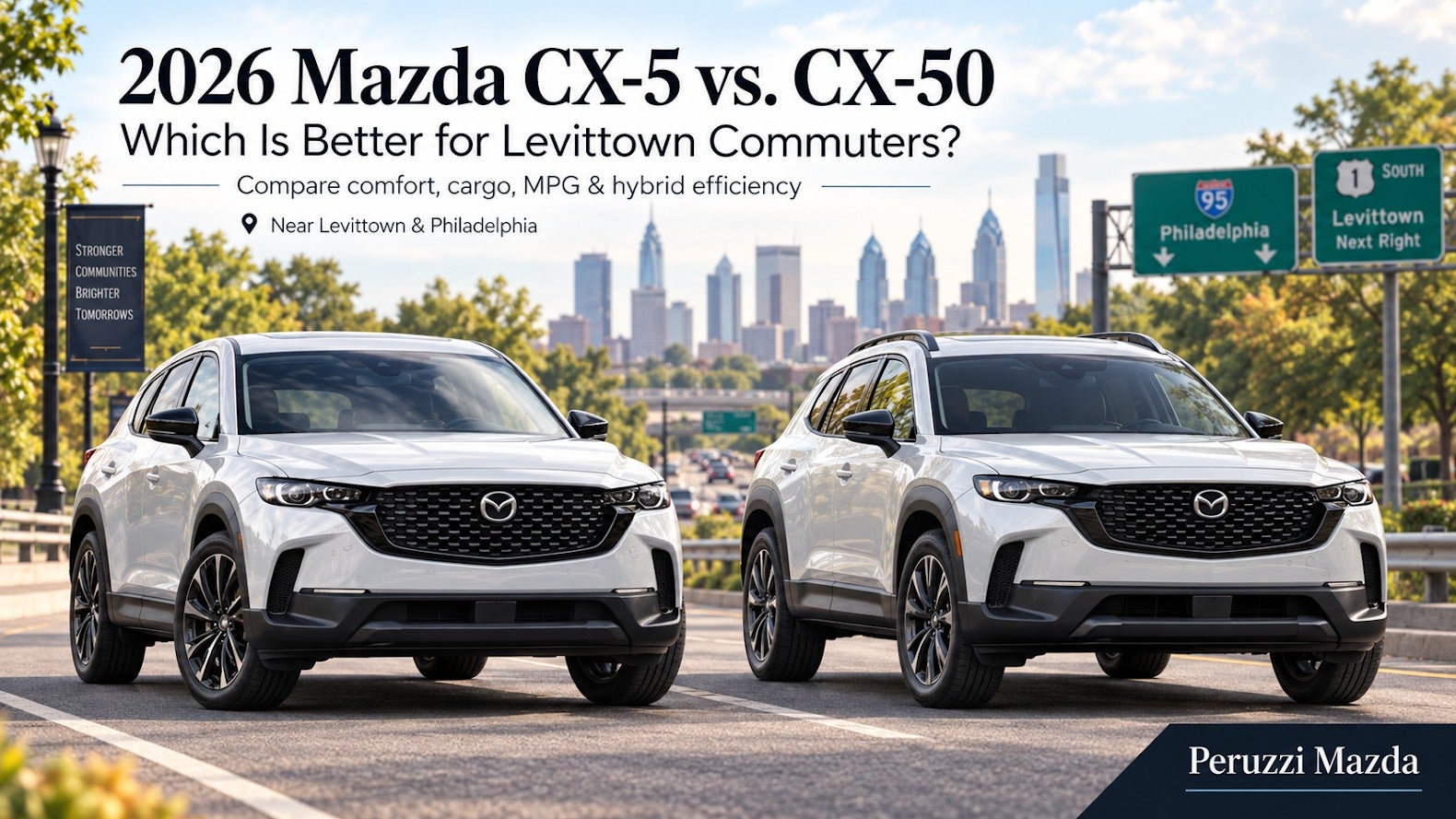
2026 Mazda CX-5 vs. CX-50: Which Is Better for Levittown Commuters?

If you commute from Levittown to Philadelphia every day, whether your route takes you along Route 1, I-95, or a combination of both, fuel economy, comfort, cargo space, and everyday usability can all play a role in which SUV makes the most sense for your drive. Two Mazdas keep coming up for commuters in this area: the all-new 2026 Mazda CX-5 and the 2026 Mazda CX-50. They sit at nearly the same starting price and share the same DNA. However, they’re built for different buyers. Here's how to figure out which one is actually right for your commute. What Are the MPG Differences Between the 2026 Mazda CX-5 and CX-50? The drive from Levittown to Philadelphia is approximately 25 miles each way, roughly 50 miles round trip, five days a week. Over a year, that's around 12,500 commuter miles before weekend driving. Fuel economy definitely matters in a situation like this. Feature 2026 Mazda CX-5 2026 Mazda CX-50 2026 Mazda CX-50 Hybrid Engine SKYACTIV®-G 2.5L 4-cyl SKYACTIV®-G 2.5L 4-cyl 2.5L Hybrid (Toyota-sourced) Horsepower 187 hp 187 hp 219 hp Torque 186 lb-ft 185 lb-ft — Transmission 6-speed automatic 6-speed automatic Automatic Drivetrain Standard i-ACTIV AWD® Standard i-ACTIV AWD® Standard AWD City MPG 24 24 39 Highway MPG 30 30 37 Combined MPG 26 26 38 At the base level, the Mazda CX-5 vs CX-50 split on paper fuel economy is exactly zero. Both are rated at 26 MPG combined. So the decision comes down to what else you're getting for that money. How Do the 2026 Mazda CX-5 and CX-50 Compare Beyond Fuel Economy? Cargo space The 2026 CX-5 gives you 66.5 cubic feet of maximum cargo space with rear seats folded, significantly more than the CX-50's 56.3 cubic feet folded (31.4 cu ft with rear seats up, or just 29.2 cu ft in the Hybrid trim). If you're hauling groceries, gear, or anything bulky after work, the CX-5 has a meaningful practical edge. Ride character The CX-5 is tuned for comfort and refinement, with a quieter cabin and softer suspension, ideal for highway miles. The CX-50 is wider and lower with a more athletic, road-hugging stance. If your Route 1 drive feels like a chore, the CX-5's cabin will make it feel less like one. If you actually enjoy driving, the CX-50 delivers more of that. The turbo option The CX-50 offers an available 2.5L Turbo engine producing 227 hp and 310 lb-ft of torque (on regular gas), with towing capacity jumping to 3,500 lbs. The CX-5 currently launches with only the naturally aspirated engine. The Hybrid option If fuel savings are your priority, the 2026 Mazda CX-50 Hybrid is worth serious consideration. It produces 219 hp combined and is EPA-rated at 38 MPG combined (39 MPG city / 37 MPG highway). Which One Is the Best Mazda SUV for Commuting? If your priority is maximum practicality and cabin comfort on a daily highway commute, the 2026 CX-5 is the better fit. More cargo space, a more refined ride, a lower entry cost, and Mazda's most popular model for a reason. If you want the most fuel-efficient option and are willing to spend a little more upfront, the CX-50 Hybrid at 38 MPG combined makes the strongest case. Especially across a 25-mile daily commute, where city-highway blended driving is where hybrid systems shine most. If driving feel matters and you want something with more punch for weekend driving beyond the commute, the CX-50 Turbo is the choice. Both come standard with i-ACTIV AWD®, Mazda Radar Cruise Control, automatic emergency braking, and Apple CarPlay / Android Auto. Neither is the wrong choice. But they serve different versions of the same Levittown commuter. Visit Peruzzi Mazda in Fairless Hills Peruzzi Mazda is located at 140 Lincoln Hwy, Fairless Hills, PA 19030, under 10 minutes from Levittown, right on the Route 1 corridor. Both the 2026 Mazda CX-5 and 2026 CX-50 are available in inventory. Test drive both back-to-back on your actual commute route and let the drive decide. FAQs Is the Mazda CX-5 or CX-50 better for highway commuting? Both are EPA-rated at 26 MPG combined on the base gas engine. The CX-5 offers a more refined highway ride; the CX-50 Hybrid at 38 MPG combined is the better option if fuel economy is the top priority. What engine options does the 2026 Mazda CX-5 come with? The 2026 Mazda CX-5 launches with Mazda's SKYACTIV®-G 2.5L 4-cylinder engine producing 187 hp and 186 lb-ft of torque, paired with a 6-speed automatic transmission and standard i-ACTIV AWD® across all trims. Does the 2026 Mazda CX-50 come in a hybrid version? Yes. The 2026 Mazda CX-50 Hybrid combines a 2.5L 4-cylinder with hybrid componentry to produce 219 hp and is EPA-rated at 38 MPG combined, making it the most fuel-efficient option in Mazda's SUV lineup for daily commuters. Is AWD standard on both the CX-5 and CX-50? Yes. Mazda offers the i-ACTIV AWD® on all trims of the 2026 CX-5 and the 2026 CX-50. Where can I test drive a Mazda CX-5 or CX-50 near Levittown, PA? The closest Mazda dealer is Peruzzi Mazda at 140 Lincoln Hwy Fairless Hills, PA 19030 about 10 minutes away via Route 1.