Blog / Mazda Information

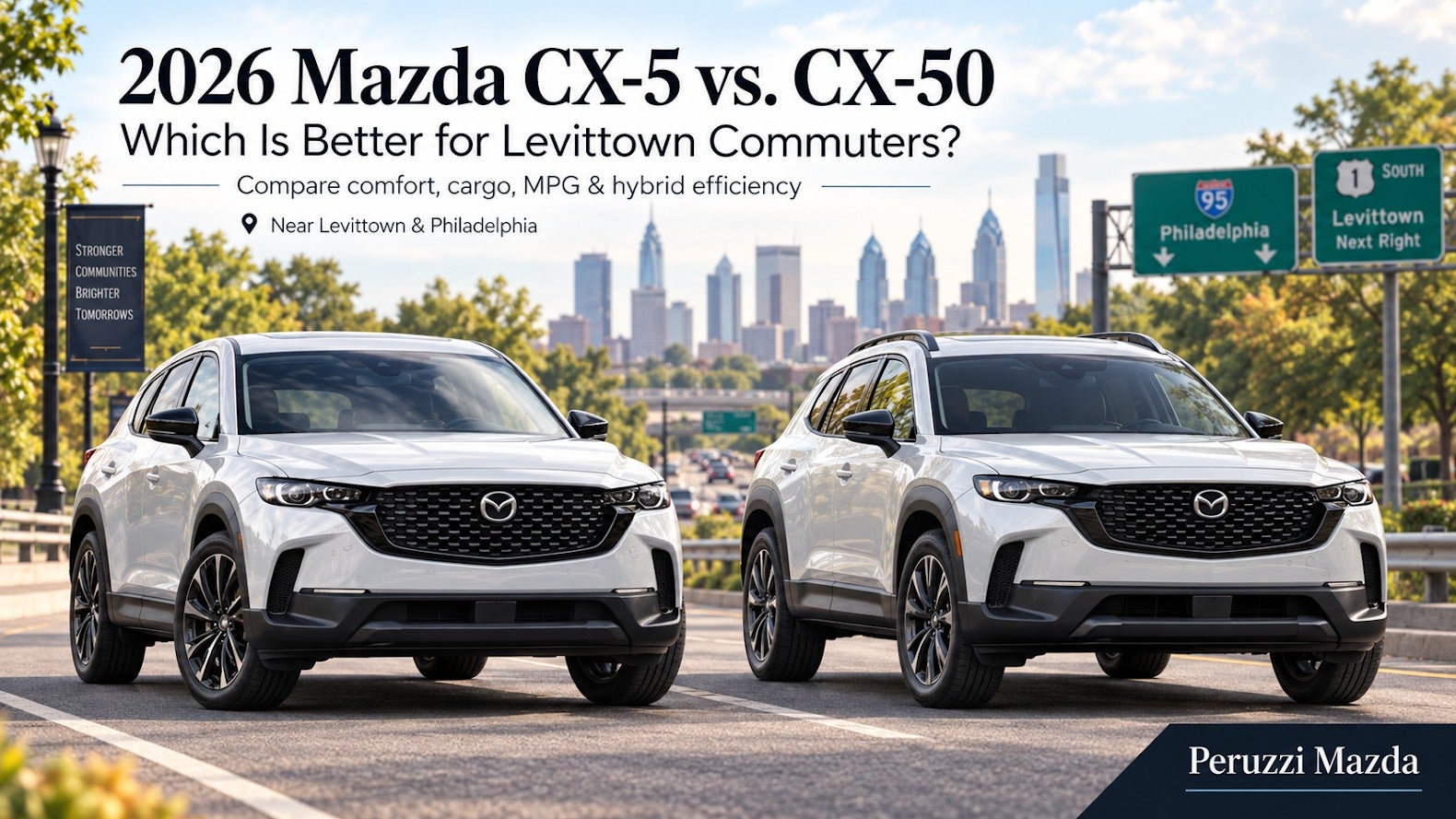
2026 Mazda CX-5 vs. CX-50: Which Is Better for Levittown Commuters?

CX-5_vs_CX-50

If you commute from Levittown to Philadelphia every day, whether your route takes you along Route 1, I-95, or a combination of both, fuel economy, comfort, cargo space, and everyday usability can all play a role in which SUV makes the most sense for your drive.

Two Mazdas keep coming up for commuters in this area: the all-new 2026 Mazda CX-5 and the 2026 Mazda CX-50. They sit at nearly the same starting price and share the same DNA. However, they’re built for different buyers. Here's how to figure out which one is actually right for your commute.

What Are the MPG Differences Between the 2026 Mazda CX-5 and CX-50? 

The drive from Levittown to Philadelphia is approximately 25 miles each way, roughly 50 miles round trip, five days a week. Over a year, that's around 12,500 commuter miles before weekend driving. Fuel economy definitely matters in a situation like this.


Feature

2026 Mazda CX-5

2026 Mazda CX-50

2026 Mazda CX-50 Hybrid

Engine

SKYACTIV®-G 2.5L 4-cyl

SKYACTIV®-G 2.5L 4-cyl

2.5L Hybrid (Toyota-sourced)

Horsepower

187 hp

187 hp

219 hp

Torque

186 lb-ft

185 lb-ft

—

Transmission

6-speed automatic

6-speed automatic

Automatic

Drivetrain

Standard i-ACTIV AWD®

Standard i-ACTIV AWD®

Standard AWD

City MPG

24

24

39

Highway MPG

30

30

37

Combined MPG

26

26

38


At the base level, the Mazda CX-5 vs CX-50 split on paper fuel economy is exactly zero. Both are rated at 26 MPG combined. So the decision comes down to what else you're getting for that money.

How Do the 2026 Mazda CX-5 and CX-50 Compare Beyond Fuel Economy?

  1. Cargo space

The 2026 CX-5 gives you 66.5 cubic feet of maximum cargo space with rear seats folded, significantly more than the CX-50's 56.3 cubic feet folded (31.4 cu ft with rear seats up, or just 29.2 cu ft in the Hybrid trim). If you're hauling groceries, gear, or anything bulky after work, the CX-5 has a meaningful practical edge.

  1. Ride character

The CX-5 is tuned for comfort and refinement, with a quieter cabin and softer suspension, ideal for highway miles. The CX-50 is wider and lower with a more athletic, road-hugging stance. If your Route 1 drive feels like a chore, the CX-5's cabin will make it feel less like one. If you actually enjoy driving, the CX-50 delivers more of that.

  1. The turbo option

The CX-50 offers an available 2.5L Turbo engine producing 227 hp and 310 lb-ft of torque (on regular gas), with towing capacity jumping to 3,500 lbs. The CX-5 currently launches with only the naturally aspirated engine.

  1. The Hybrid option

If fuel savings are your priority, the 2026 Mazda CX-50 Hybrid is worth serious consideration. It produces 219 hp combined and is EPA-rated at 38 MPG combined (39 MPG city / 37 MPG highway). 

Which One Is the Best Mazda SUV for Commuting?

If your priority is maximum practicality and cabin comfort on a daily highway commute, the 2026 CX-5 is the better fit. More cargo space, a more refined ride, a lower entry cost, and Mazda's most popular model for a reason.


If you want the most fuel-efficient option and are willing to spend a little more upfront, the CX-50 Hybrid at 38 MPG combined makes the strongest case. Especially across a 25-mile daily commute, where city-highway blended driving is where hybrid systems shine most.


If driving feel matters and you want something with more punch for weekend driving beyond the commute, the CX-50 Turbo is the choice.


Both come standard with i-ACTIV AWD®, Mazda Radar Cruise Control, automatic emergency braking, and Apple CarPlay / Android Auto. Neither is the wrong choice. But they serve different versions of the same Levittown commuter.

Visit Peruzzi Mazda in Fairless Hills

Peruzzi Mazda is located at 140 Lincoln Hwy, Fairless Hills, PA 19030, under 10 minutes from Levittown, right on the Route 1 corridor. Both the 2026 Mazda CX-5 and 2026 CX-50 are available in inventory. Test drive both back-to-back on your actual commute route and let the drive decide.

FAQs

  1. Is the Mazda CX-5 or CX-50 better for highway commuting?

Both are EPA-rated at 26 MPG combined on the base gas engine. The CX-5 offers a more refined highway ride; the CX-50 Hybrid at 38 MPG combined is the better option if fuel economy is the top priority.


  1. What engine options does the 2026 Mazda CX-5 come with?

The 2026 Mazda CX-5 launches with Mazda's SKYACTIV®-G 2.5L 4-cylinder engine producing 187 hp and 186 lb-ft of torque, paired with a 6-speed automatic transmission and standard i-ACTIV AWD® across all trims.

  1. Does the 2026 Mazda CX-50 come in a hybrid version?

Yes. The 2026 Mazda CX-50 Hybrid combines a 2.5L 4-cylinder with hybrid componentry to produce 219 hp and is EPA-rated at 38 MPG combined, making it the most fuel-efficient option in Mazda's SUV lineup for daily commuters.

  1. Is AWD standard on both the CX-5 and CX-50?

Yes. Mazda offers the i-ACTIV AWD® on all trims of the 2026 CX-5 and the 2026 CX-50.

  1. Where can I test drive a Mazda CX-5 or CX-50 near Levittown, PA?

The closest Mazda dealer is Peruzzi Mazda at 140 Lincoln Hwy Fairless Hills, PA 19030 about 10 minutes away via Route 1.



Posted in:

Related Posts

Does AWD Help on Dry Roads Too? How Mazda i-ACTIV AWD Really Works

All-wheel drive most think of snow, ice, and slick streets. But the benefits of Mazda's available i-ACTIV AWD can extend far beyond just inclement conditions. The system analyzes real-time driving conditions and the driver's inputs, then distributes torque accordingly to promote optimal stability and grip. The result: increased confidence on commutes, rainy-weather driving, acceleration, and other evolving road surfaces. It works whether you're taking a short local trip or an extended road expedition. 1. Does AWD Actually Help on Dry Roads? Yes. AWD can be of service when the pavement is bone dry. “When driving on dry roads, i-ACTIV AWD can help secure traction when accelerating and cornering by distributing torque appropriately to the front and rear wheels.” “During everyday driving, that can translate to increased stability and a greater sense of control when accelerating on a highway, exiting an intersection, or traveling on roads where traction can fluctuate.” 2. How Does Mazda i-ACTIV AWD Work? Instead of reacting after a wheel slips on the road, Mazda's i-ACTIV AWD monitors various sensors and systems in the vehicle—such as wheel speed and steering angle data from the driver, as well as information on ambient temperature and windshield-wiper status and brake pedal position—to predict conditions and control torque flow. Mazda notes that control of the flow of torque between the front and rear wheels goes beyond 200 calculations per second, allowing the vehicle to anticipate variations. 3. What About Rain and Wet Roads? That is where AWD can really help in daily driving. Tire traction may become limited by rain, especially when you are launching from a standstill, merging onto a highway, or making a turn on a wet road.Mazda's i-ACTIV AWD is supposed to monitor the ever-changing situation and actively distribute the torque to maintain traction, and it can be very helpful even in a downpour, even if you never see snow or ice. 4. Does AWD Make a Mazda Better in Corners? This isn't just a mechanism to help you get going, however. Mazda's system can actually be paired up with other dynamic-control technology in order to aid torque distribution when cornering. The idea here is a seamless experience rather than an intrusive one, with i-ACTIV AWD aiming to provide "stability and traction, but at the same time complement the natural feel..." 5. Which Mazda Models Offer i-ACTIV AWD? i-ACTIV AWD Mazda puts the all-wheel-drive system on pretty much the whole SUV lineup, although what specifically you get depends on the car. For a 2026 Mazda CX-5, that will include i-ACTIV AWD as standard fare on most trims. On the CX-90, it's on the heavier-duty version with a rear bias.Another recent example is the 2026 Mazda CX-30, which can already be had with it available as part of its typical i-ACTIV AWD trim package configuration. 6. Does AWD Mean You Can Ignore the Road Conditions? No. AWD can give you a bit of additional traction but doesn’t guarantee you will have traction while at excessive speeds or driving unsafely or without focus. Mazda’s fine print states their AWD technology may not be equipped to assist in all driving situations.Although it can give you some help when starting and keeping traction, the tires provide the contact with the road—the connection your Mazda has to the road surface. In snowy conditions, having the right winter tires is almost as crucial as the drivetrain. 7. Is Mazda i-ACTIV AWD Worth It? Most drivers need to experience reliable grip and handling that doesn’t make them shift between modes at the last moment for conditions such as rain and changing surfaces or inclines (even during brief winter spells). You’ll appreciate having this additional boost of traction even on dry roads.Visit us in Fairless Hills, check out the New Mazda Inventory here at Peruzzi Mazda, and search through various models and trims in our SUVs today.

CX-30, CX-5, CX-50, CX-70 or CX-90? The Mazda SUV Size Guide for Real Life

So, you need a new Mazda SUV. Does that mean opting for the largest SUV with Mazda’s largest SUV price tag? More importantly, the issue may not be about how much SUV you’re able to pay for, but rather how much SUV is right for you. Mazda’s collection of sport utility vehicles includes everything from the relatively compact CX-30 to a vehicle you can practically turn into a rolling living room or a house on wheels, in the case of the CX-90. 1. Mazda CX-30: Best for City Driving This is the smallest of the SUVs we tested and could be ideal for urban motorists or those who really don't need a big interior. It has room for five and, thanks to a compact design, is easy to get into tight spaces to park or turn around while still being an SUV.The CX-30 could be ideal if you want to have a more manageable size for an SUV while still having a usable passenger and cargo space. Best for: Commuters, couples, and smaller households. 2. Mazda CX-5: The Everyday All-Rounder It offers a nice middle ground. The CX-5 offers a five-person cabin with more passenger and cargo space than the CX-30 while not being too big to handle on a daily basis. This vehicle would suit anyone who would like the comfort of being able to accommodate the rest of their family and haul groceries, luggage, or everyday belongings without having to upgrade to an even larger three-row vehicle. Best for: Families who want a practical SUV without moving into a larger three-row vehicle. 3. Mazda CX-50: For More Adventure Seating for five is also found in the CX-50, which boasts a more outdoorsy persona. This Mazda and what it’s capable of doing will appeal to buyers looking for an SUV that is equally comfortable commuting and taking to the trails on weekend excursions.The CX-50 is rated to tow a maximum of 3,500 pounds when equipped with the turbo engine and Towing Mode. Best for: Drivers who want more capability for outdoor activities, gear, and weekend trips. 4. Mazda CX-70: More Space Without a Third Row The CX-70 is a full-size two-row SUV aimed at buyers who require more space but don't feel they need a third row. It makes sense as a candidate when space for people and the cargo hold are more important than passengers.This extra space comes in handy when travelling as a family, on a road trip, for sporting equipment, for luggage, or for large loads, but at the cost of not having to carry a third row of passengers. Best for: Families and active drivers who want substantial cargo space but don't need a third row. 5. Mazda CX-90: When You Actually Need Three Rows Choose the CX-90 if seating space is top priority. This SUV can accommodate up to eight passengers depending on setup and offers a second, sliding third-row seat for extra room.It is the family mover that frequently has many people in the SUV and needs the functionality that three rows offer while gaining ample cargo space when reconfigured. Best for: Larger families, frequent passengers, and drivers who regularly need three rows. 6. Which Mazda SUV Fits Your Life? Mazda SUV Seating Best For CX-30 5 City driving and smaller households CX-5 5 Everyday family driving CX-50 5 Outdoor activities and added capability CX-70 5 More passenger and cargo space without a third row CX-90 Up to 8 Larger families and three-row needs The largest SUV will not always be your best option. Commuting by yourself most of the time, then the CX-30 might be more worth the purchase than paying for space you will never use. If you have a small growing family, the CX-5 or the CX-50 could be a good fit for you. If you find you always have a couple of people in your vehicle, you might be better off picking the CX-70 or CX-90 Find the Right Mazda SUV at Peruzzi Mazda We’re going to put all the new CX series up against one another to make it easy for you. What should you look for when shopping for CX-30, CX-5, CX-50, CX-70, or CX-90?First, what does your life look like?This means how many people do you haul, what do you carry, is a third row a priority, and do you want something that offers capability or tow support?Browse our Peruzzi Mazda New Mazda CX lineup here in Fairless Hills to compare every new CX size to find what works for your lifestyle.

Turbo vs. Non-Turbo Mazda: Who Actually Needs the Extra Power?

Choosing your next Mazda: Turbo or Natural Aspiration. As soon as you have decided to buy a Mazda, you then start debating the merits of a turbo against a naturally aspirated engine. Both kinds of engines are comfortable to drive but offer you a totally different feeling behind the wheel. In daily life, a naturally aspirated engine would more than likely suit you, while on occasions when that extra burst of acceleration and torque is needed, it is more noticeable when merging, overtaking, climbing, or carrying weight. 1. Non-Turbo: Who Is It For? A naturally aspirated Mazda is a wonderful choice for daily commuting, running errands, and standard highway journeys. They deliver power in a clean and predictable way, allowing for an experience that’s easy to handle throughout the day without having to pay for power that you may not need often.It might be the right Mazda if: Mostly drive around town Don't regularly tow Want predictable everyday performance Don't need extra acceleration Most people spend the majority of their time driving to school, doing the shopping, picking up children, going into town, or on other routine journeys. If this applies to you, a non- turbo engine might be everything you require. 2. Turbo: What Do You Gain? Adding forced induction to an engine usually increases horsepower and torque, which may feel like a real advantage when merging onto the freeway, taking over other cars, struggling with steep grades, or hauling weightier burdens. More torque could leave your ride feeling more reassured in the event you solicit greater acceleration. For instance, a car equipped with a forced-induction engine, such as the upcoming year (2026) Mazda CX-50 that offers a 2.5 Turbo with a high of 256 horsepower and 320 pound-feet, when utilizing 93 premium fuel, while the 87 octane normal gas offers 227 horsepower and 310 lb-ft of torque. 3. Who Actually Needs the Turbo? The turbo only becomes really advisable if you frequently take a lot of passengers with you, carry large or heavy loads, frequently drive on hilly terrain, require significantly enhanced acceleration, or would rather have more tow capacity than just extra horsepower written on paper.The turbo might be recommended if you: Carry several passengers or heavy cargo Drive in hilly areas Want stronger acceleration Tow a trailer Prefer a more powerful driving experience With optional equipment, the 2026 CX-50 2.5 Turbo can tow up to 3,500 lbs. 4. Turbo or Non-Turbo: Which Should You Choose? Go for the non-turbo if all you want is straightforward performance for your daily driving needs. If you primarily commute to work, drive your family around, and take regular highway trips without towing or carrying heavy loads, the non-turbo engine should provide more than enough power. A turbo is suggested when you want extra power and torque. Useful when towing, carrying heavier loads, or when you want quicker acceleration in addition to the added punch of torque. The most powerful engine isn't always the best choice. The right engine is the one that best matches your driving needs, typical routes, and how you plan to use your Mazda. Find Your Mazda at Peruzzi Mazda If you’re unsure whether turbo or non-turbo power suits you best, you can always take the time to look up the various models and configurations in the Mazda lineup to see what is best for the kind of driving you do. Nothing beats seeing the cars themselves to get better insight into their equipment differences and engine options. If you need assistance understanding your choices, see New Mazda Inventory here at Peruzzi Mazda to find the Mazda you need!